Contexts of Lambeth walk
Lambeth Walk is a walk, a song, a dance, two films, a photograph, a market and a street in Kennington, London.
https://www.vauxhallandkennington.org.uk/lambethwalk.shtml
The street
The original "Lambeth Walk" was an evening promenade by the predominantly poor residents of North Lambeth:- that is the area around Black Prince Road.
It was for many years the site of a thriving street market but it was badly damaged by bombing in the Second World War.
The Greater London Council embarked on a wholesale redevelopment of the area in the 1960s, but the earlier atmosphere was never regained, even though a few shops and stalls continued in its modern new surroundings
It has since been the subject of some further controversial redevelopment proposals, as recorded by Michael Ball in the Observer on 7 July 2002:-
.jpg)
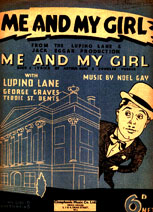
The walk was popularised by Noel Gay who wrote the song Doin' the Lambeth Walk with its catchy tune for the 1937 Douglas Furber musical comedy Me and My Girl.
Every little Lambeth gal,
With her little Lambeth pal,
You'll find them all
Doing the Lambeth Walk.
Everything's free and easy,
Do as you darn well pleasy,
Why don't you make your way there
Go there, stay there.
Once you get down Lambeth way
Every evening, every day,
You'll find yourself
Doing the Lambeth Walk.oi!

https://www.vauxhallandkennington.org.uk/lambethwalk.shtml
The street
The original "Lambeth Walk" was an evening promenade by the predominantly poor residents of North Lambeth:- that is the area around Black Prince Road.
Lambeth Walk was the site of two wells, the road to which slowly became lined with houses of one sort or another.
http://vauxhallhistory.org/lambeth-wells/
By the 1840s ‘The Walk’ had a well-established market and by 1861 it was thriving with 164 costermongers’ stalls.
The following is based on an articles by Peggy Sheath published in The Vauxhall Society’s Newsletter during 1980.
A street market was in existence in Lambeth Walk by the 1860s. In a report by the London County Council dated 6 December 1901, from a survey made that year, it is stated: “It is noticeable that the street markets of London are to be found in the greatest numbers and in the most flourishing condition in the midst of densely populated arid poor neighbourhoods. They fulfil a most useful purpose as they are largely the means by which the surplus produce remaining unsold in the authorised markets is distributed amongst the poorer classes.
More about what the market sold: http://vauxhallhistory.org/lambeth-walk-street-market/
A tiny ramshackle stall filled with dusty tins of boot polish, strong packs of laces and a few stale pieces of soap; on guard was a very young woman with a pram and a baby each side of her. Her face was deathly pale underneath it’s coating of grime.
A fish stall reeking horribly, with nothing but three pieces of dogfish laid on the boards. A man dusted off the fish with an oil-stained rag.
A vegetable stall with bananas half-opened to show how good they were to eat.
China cups at a penny, but with no saucers.
Goats’ milk and live eels.
Home-made wines by the glass; cordials at 1d and 2d per glass.
The people looked half starved.
A fish stall reeking horribly, with nothing but three pieces of dogfish laid on the boards. A man dusted off the fish with an oil-stained rag.
A vegetable stall with bananas half-opened to show how good they were to eat.
China cups at a penny, but with no saucers.
Goats’ milk and live eels.
Home-made wines by the glass; cordials at 1d and 2d per glass.
The people looked half starved.
The writer of this article has been able to draw on the memories of people in the district for other information about the Walk. It is generally remembered as incredibly poor but seemingly cheerful; the poor knew each other well and helped each other out.
“Tuppenny Lean” – a room where the proprietor placed a rope across at about shoulder height for the patrons to lean on and have a sleep.
In the 1920s, you could fill your bags with groceries for less than 10/- (ten shillings – 50p); the shops remained open until at least 9pm and the streets were full of laughter and singing in the pubs. You could get your supper by taking any of your bed linen to the pawnbrokers and managing to ‘rough it’ for a night or two.
It was for many years the site of a thriving street market but it was badly damaged by bombing in the Second World War.
The Greater London Council embarked on a wholesale redevelopment of the area in the 1960s, but the earlier atmosphere was never regained, even though a few shops and stalls continued in its modern new surroundings
It has since been the subject of some further controversial redevelopment proposals, as recorded by Michael Ball in the Observer on 7 July 2002:-
- Whole communities, such as those within Lambeth, were transported to the 'overspill' estates and new towns. Streets of slums were redeveloped into brave new housing blocks, pedestrianised shopping centres, high-level walkways, unlandscaped open spaces.
At Lambeth Walk, 2,000 homes, 100 shops, five pubs and one church were replaced with half the homes and shops, one pub, no churches, and a park. There was no discussion of the needs of the community. They were just shipped out. The remaining adjacent estates didn't take kindly to the new communities eventually shipped in.
By the 1990s, Lambeth Walk was considered a failure, dilapidated, with empty shops, low educational attainment and employment. So back came the local authority, but 40 years on they were armed with that essential Blairite tool: a public-private partnership with big-league developers. This time there was some dialogue with the community, but the solutions were similar: the complete razing of the estate, to be replaced by another planner's vision of tomorrow. They call it regeneration, but it is really comprehensive redevelopment by committee. And unlike the original comprehensive redevelopment - which at least got results - no homes have been built, since the local community rejected the proposals. Why? Because they didn't work with the best of what there is: the maturing trees in the park, the youth club, the networks of families and friends that met in the remains of the shopping centre. Teenage pregnancy wasn't addressed, nor was drug crime or youth alienation. And, most of all, it was rejected because the professionals were no longer trusted.
The walk was popularised by Noel Gay who wrote the song Doin' the Lambeth Walk with its catchy tune for the 1937 Douglas Furber musical comedy Me and My Girl.
The story line is about a Cockney barrow boy who inherits an earldom and almost loses his Lambeth girlfriend.
Any time you're Lambeth way,
Any evening, any day,
You'll find us all
Doing the Lambeth Walk.
Any evening, any day,
You'll find us all
Doing the Lambeth Walk.
Every little Lambeth gal,
With her little Lambeth pal,
You'll find them all
Doing the Lambeth Walk.
Everything's free and easy,
Do as you darn well pleasy,
Why don't you make your way there
Go there, stay there.
Once you get down Lambeth way
Every evening, every day,
You'll find yourself
Doing the Lambeth Walk.oi!
| The stage show was enormously popular, as can be seen from the following New York Times report of May 2, 1939:- |
- "BRITISH KING GETS LESSON FROM 'LAMBETH WALK' STAR. Lupino Lane, star of the show, was presented to the King and Queen after the performance. "They said they had been walking the Lambeth Walk the wrong way - the ballroom way - and promised to do it our way in the future.""
Lambeth Walk - Nazi Style
1939 also saw the beginning of World War II and in 1942 Len Lye made a short propoganda film Lambeth Walk - Nazi Style which, through ingenious editing, purported to show Hitler and his elite guards marching and dancing to The Lambeth Walk.
A photograph
Photographed by Bill Brandt
East end girl, dancing the Lambeth Walk, 1939
He’s set it up, of course. Or, rather, framed it.
There’d be no feigning this young woman’s delight
in being ‘free and easy’ and doing
‘as you darn well pleasy’. She’s got her best blouse on,
with shoulder puffs, her sister’s shoes, which fit her now,
black ankle socks and shoulder length, unpermed hair
freshly washed – and waved, probably with Kirby grips.
Doin’ the walk, she lifts the hem of her skirt,
revealing her slip – and smiles coquettishly.
Beside her is a line, a queue almost of
Beside her is a line, a queue almost of
female acolytes. (The only boy looks away).
They’re pre-pubescent, excited, nervous at what they see:
grown up clothes, shapely legs, unimaginable bust,
a sensuousness that, unwilled, will be theirs.
Down the street of terraced houses, symmetrical
Down the street of terraced houses, symmetrical
as barracks, a woman strides, her back turned
on this miracle: a girl who knows
she will never grow old – ‘Any ev’ning,
any day…Doin’ the Lambeth Walk.’ Oi!
A sense of performance, being ‘free and easy’ and doing ‘as you darn well pleasy’ as lower working class?
https://www.davidselzer.com/2012/05/east-end-girl-dancing-the-lambeth-walk-bill-brandt/
In 1943, the British magazine Picture Post ran a Bill Brandt photograph Dancing the Lambeth Walk of a girl dancing in front of friends on a London street - not Lambeth Walk, as far as I know. The photo was used to illustrate the unfortunate consequences of the lack of youth clubs - kids were forced to play "juvenile games" in city streets.
Just seven years later, however, Picture Post ran the same photo again, this time with an article that called for a return to the days before massive slum removal, when the charming sight of children playing in the streets was common.
"The girl lived in Bethnal Green, in the East End of London,” writes Ian Jeffrey in The Photography Book. “At the photographer’s request she is dancing the Lambeth Walk, a dance made famous in the 1930s. Although dressed in an ill-fitting assortment of clothes, she performs with elegance and self-possession.”
https://uk.phaidon.com/agenda/food/articles/2017/may/02/photos-that-changed-the-world-the-lambeth-walk/
The dance
It is – as Eddie Cantor said in his recent broadcast – a freak among modern ballroom dances. It is the only one which has originated here and not the United States. Now it has crossed the Atlantic and is to be seen in New York. In this country three million people are said to be doing it, some of them, no doubt, surprised that anything so simple and so unmodern can be so enjoyable.
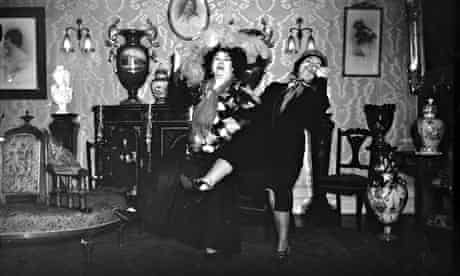
Kate Carney, London's coster queen of the music halls, practising the Lambeth Walk with her daughter Dolly, 5 October 1938
... then evolved the knee-slapping, the stamps, the turns and the shout of "Oi".
https://www.theguardian.com/theguardian/2014/jul/26/archive-1938-lambeth-walk-dance
Lane explained the origin of the dance as follows: "I got the idea from my personal experience and from having worked among cockneys. I'm a cockney born and bred myself. The Lambeth Walk is just an exaggerated idea of how the cockney struts."
Comments
Post a Comment